
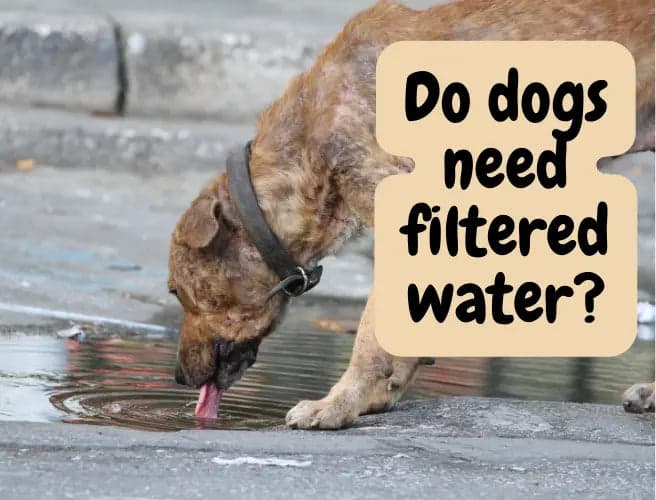
Water quality for pets is a topic we've not really approached before. It's often taken for granted that if tap water is good enough for us, then it's also good enough for our dogs and cats.
But is our unfiltered tap water actually good enough for us?
While tap water in the UK and USA have some of the strictest water quality regulations globally, accidents still happen. A 2023 report from DWI illustrates that in fact all the substances listed as potentially harmful are regulated to safe levels in the UK tap water.
This doesn't mean that there are no contaminants. What it does mean is that the low level of contaminants have so far not been found to be harmful to the human body.
Furthermore, there have been a number of incidents in which dangerous bacteria had infiltrated the water supplies. The most recent of this is the May 2024 outbreak affecting South West England in which 22 cases of cryptosporidiosis have so far been confirmed.
Cryptosporidiosis in dogs
Cryptosporidiosis is a parasitic disease caused by a parasite that can infect both humans and dogs. The infection can lead to gastrointestinal issues, such as diarrhoea, vomiting, and abdominal discomfort in dogs.
While many dogs may exhibit mild or no symptoms, it can be more severe in puppies, older dogs, or dogs with weakened immune systems. In such cases, the infection can cause significant dehydration and weight loss due to prolonged diarrhoea. It often passes away on its own, but sometimes does require anti-parasitic medication as well.
Probiotics may also help in improving your dog's gut flora and helping them get over an acute infection.
Water Quality for Dogs
Water is essential for all living beings, including our canine companions, cats, chicken or whatever other animals you may have at home. It plays a vital role in various bodily functions, such as digestion, nutrient absorption, temperature regulation, and waste elimination.
Ensuring that your pets have access to clean and safe water is crucial for maintaining their overall health and well-being.
If in doubt and want to get a better illustration of your tap water quality, there are companies such as Aqua Vue that offer water testing kits by mail.
Types of Water Filters and Their Effectiveness
There are several types of water filters available, each with its unique mechanism for removing contaminants. I do want to emphasize that by investing in a water filter, it's going to be both your human family AND your four legged companions who are going to benefit.
Unless if you live in a particularly remote, mountainous area, I believe the majority of water supplies are contaminated in one way or another with particulates that are not healthy for any living being.
These contaminants can vary from bacteria to heavy metals, PFAS, VOCs, micro plastics, detergents, etc.
At the end of the day, wouldn't you rather drink water with 0 contaminants compared to water with contaminants but below some arbitrary limits?
Here are three water filter types to consider for you and your family (including your pets).
1. Reverse Osmosis (RO) Water Filter
RO systems use a semi-permeable membrane to remove a wide range of contaminants by forcing water through the membrane, leaving impurities behind. The reverse osmosis membrane is often part of a multi water filtration system.
Prior to the water passing through the RO membrane, if often passes through at least one sediment filter (for large particles) and a carbon filter.
These systems are highly effective at removing heavy metals (such as lead, mercury, and arsenic), fluoride, nitrates, bacteria, and viruses.
RO systems are typically installed under the sink or as whole-house filtration systems. They require regular maintenance and periodic replacement of the membranes and pre-filters. These systems are more expensive than other filter types but are also the most effective.
2. UV Filters
UV filters can be either used on their own, or part of a reverse osmosis system or multi-stage water filtration set up.
UV purifiers are effective at disinfecting water, killing pathogens such as E. coli and other harmful microorganisms. However, they do not remove chemical contaminants or heavy metals.
If you want a comprehensive water filtration, you must use these with other water filters. They may be used on their own if your water source is from a well, or other private water sources and bacteria or viruses are your main concern.
3. Activated Carbon Filters
Activated carbon filters are the most common type of water filters. This is the type you will find in the famous Brita water jugs.
They're cheap, portable and very lightweight.
They may improve the taste and smell of water by reducing certain contaminants, but they often do not filter out the smallest of particles.
Activated carbon filters work best when part of a reverse osmosis filtration system, otherwise they will not remove all of the chlorine, volatile organic compounds, pesticide, herbicides, etc.
Activated carbon filters are also commonly found in water filter pitchers, faucet-mounted filters, and refrigerator filters.
The 10 most common water contaminants in the UK
Contaminant
Description
Health Impact
Filtration Method
Chlorine
Disinfectant used in water treatment
May cause dry skin and irritate the eyes and nose
Activated Carbon
Lead
Heavy metal from old plumbing systems
Can cause developmental issues in children, kidney damage
Reverse Osmosis, Activated Carbon
Nitrates
From agricultural runoff of fertilizers
Can affect oxygen transport in the blood
Reverse Osmosis
Pesticides
Chemicals used in agriculture to kill pests
Linked to various health issues
Activated Carbon, Reverse Osmosis
PFAS (Forever Chemicals)
Synthetic chemicals used in various products e.g. non stick pans, fire extinguishers, carpets, etc
Linked to cancer, liver damage, and other health issues
Activated Carbon, Reverse Osmosis
Bacteria and Viruses
Pathogens from various sources
Can cause gastrointestinal illnesses
UV Purifiers
Fluoride
Added to water to prevent tooth decay
Excessive intake can lead to skeletal fluorosis
Reverse Osmosis
Heavy Metals (e.g., Mercury, Arsenic)
Naturally occurring or from industrial pollution
Toxic and can cause various health problems
Reverse Osmosis, Activated Carbon
Sediment
Particles from pipes and water sources
Generally not harmful but can affect water quality
Reverse Osmosis
Trihalomethanes (THMs)
Byproducts of chlorine disinfection
Linked to cancer and reproductive issues
Activated Carbon
Source used: Drinking Water Inspectorate
Out of the three water filtration methods I talked about, it's only the reverse osmosis system that is able to filter out all of these contaminants.
My preference
I have to say that getting a reverse osmosis water filtration system fitted under my sink has been my best decision of last year. I'm not going to make product recommendations so as to keep this advice genuine. However, you can have a browse yourself on Google and go for a system with good reviews if you are interested in improving your tap water quality.
Living in central London where the water quality isn't best, has also impacted my decision. I also have to say that my pets are drinking more since I have started giving them filtered water. Animals such as cats and dogs are very sensitivity to smelly chemicals such as chlorine and they may avoid drinking if they don't like the taste.
If your dog or cat isn't drinking enough water, or if they suffer from kidney disease or recurrent urine. infections, then giving filtered water a go might be life changing for them!